Roth vs. Traditional IRA: Which Saves You More?
The answer depends on one question: will your tax rate be higher now or in retirement?
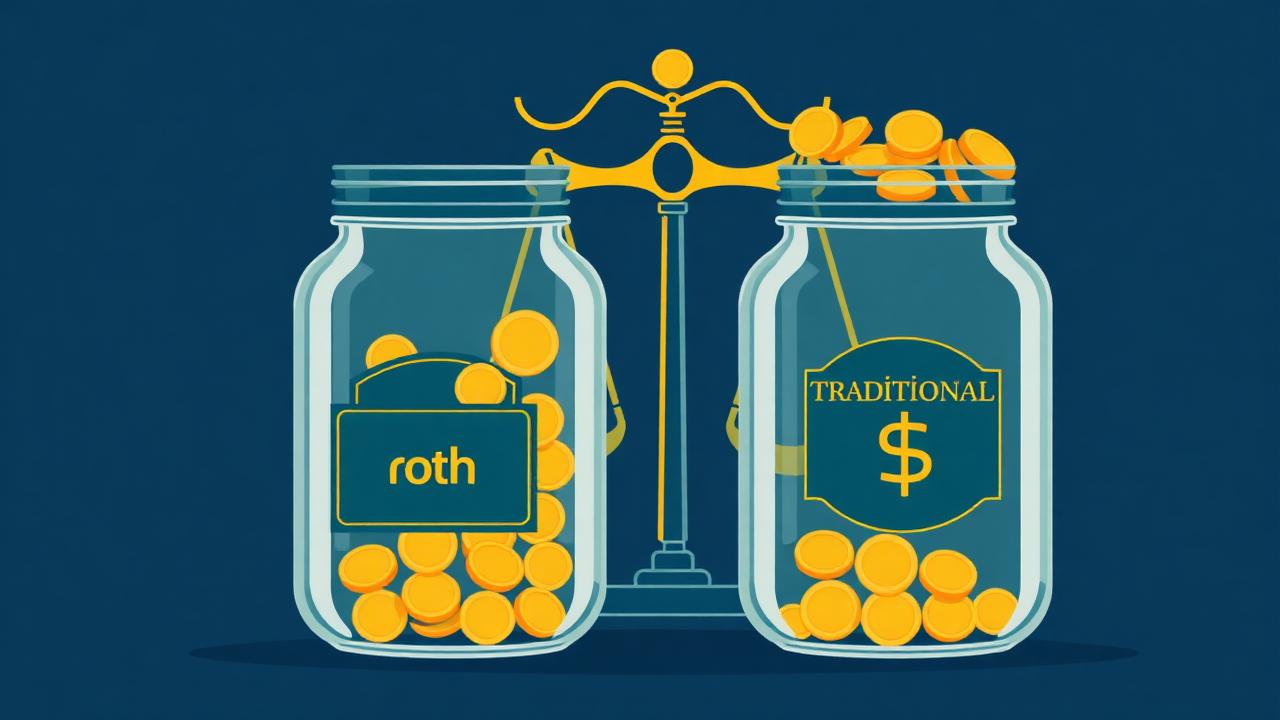
Table of contents
The Roth vs. Traditional IRA debate gets way more complicated than it needs to. There's one question that decides 80% of cases: will your marginal tax rate in retirement be higher or lower than it is today? Answer that and the rest is detail.
How each one works
- Traditional IRA — deduct contributions today, pay ordinary income tax on every dollar withdrawn in retirement.
- Roth IRA — pay tax on contributions today, then both growth and withdrawals are tax-free forever.
Both share a $7,000 annual limit ($8,000 if 50+) in 2026, and both grow tax-deferred. The only meaningful difference is when the IRS collects.
The simple rule of thumb
If your tax rate will be HIGHER in retirement → Roth (pay tax now at the lower rate). If your tax rate will be LOWER in retirement → Traditional (defer the tax to a cheaper bracket).
For most people in their 20s and 30s — early career, lower bracket, decades of income growth ahead — Roth wins. For peak earners in their 40s and 50s, Traditional often pencils out.
Why Roth dominates for young earners
- Decades of tax-free growth — a $7k contribution at 25 can be $150k tax-free at 65.
- No Required Minimum Distributions (RMDs), ever.
- Contributions (not earnings) can be withdrawn penalty-free at any time — making it a backup emergency fund.
- Tax diversification — gives you a tax-free bucket to draw from in high-bracket retirement years.
When Traditional still wins
You're in a 32%+ federal bracket today and plan to retire in a low-tax state with modest spending. The deduction is worth thousands now, and you'll likely pull it back out at 12-22%. That arbitrage is real money.
If you're certain your tax rate will be lower in retirement, Traditional is mathematically better. Most people are wrong about that certainty.
Income limits — read this
Roth IRA direct contributions phase out at higher incomes (~$165k single / ~$246k married in 2026). Above that, use the 'Backdoor Roth' — contribute to a non-deductible Traditional IRA, then immediately convert to Roth. It's a well-established, IRS-blessed move.
The 'split' strategy
You don't have to choose. Many planners suggest splitting between Roth IRA and Traditional 401(k) — Roth for the IRA (where you'd otherwise lose tax-free growth) and Traditional for the 401(k) (where the deduction is biggest).
Frequently asked questions
Can I have both?+
Yes — your combined IRA contributions are capped at $7k/year ($8k if 50+), but you can split between Roth and Traditional any way you want.
What's the Backdoor Roth?+
A legal workaround for high earners: contribute to a non-deductible Traditional IRA, then convert to Roth. Watch the pro-rata rule if you have existing Traditional IRA balances.
When can I withdraw Roth contributions?+
Contributions (not earnings) can come out any time, any age, tax- and penalty-free. Earnings require age 59½ and a 5-year-old account.
What about Roth 401(k)?+
Same tax treatment as Roth IRA, with much higher limits ($23k+) and no income cap. Excellent for high earners.
Does converting Traditional to Roth make sense?+
Often, in low-income years (sabbatical, early retirement before Social Security). You pay tax now at a low rate to move money to a tax-free bucket forever.
I'm self-employed — what should I use?+
SEP IRA or Solo 401(k) for higher limits. Both have Roth and Traditional flavors.
Certified Financial Planner with 12 years guiding first-time investors.